|
 Pulsar Found in Our
Galaxy that is "Eating" its Companion Pulsar Found in Our
Galaxy that is "Eating" its Companion
May 24,
2002 08:30 CDT
Scientists have
found a pulsar system that has one of the lowest-mass
companions of any stellar binary in a binary star
system. The pulsar
has all but completely whittled its companion star to
only about 10 times more massive than Jupiter.
The finding
by a team at the Massachusetts Institute of Technology
(MIT)
provides clear evidence that neutron stars can slowly
steal material from their companions and dramatically
increase their spin rate, ultimately evolving into the
isolated, radio-wave-emitting pulsars spinning a
thousand times per second -- the type commonly seen
scattered throughout the Milky Way galaxy.
The
maligned companion, once a bright orange gem probably
more than half the mass of the Sun
(equivalent to 500 times the mass of Jupiter), has
slowly grown dimmer and dimmer and will vanish
eventually.
Dr. Ron
Remillard of the MIT Center for Space Research
discovered the pulsar along with Drs. Jean Swank and Tod
Strohmayer of NASA Goddard Space Flight Center. The X-ray
source, named XTE J0929-314, was found in mid May, 2002,
during a routine survey of the sky with NASA's Rossi
X-ray Timing Explorer.
Dr. Duncan
Galloway, a postdoctoral associate at MIT, performed the
follow-up observation that revealed the pulsar system's
unique properties. Other members of the MIT observation
and analysis team include Dr. Edward Morgan and
Professor Deepto Chakrabarty.
"This
pulsar has been accumulating gas donated from its
companion for quite some time now," said Galloway. "It's
exciting that we are finally discovering pulsars at all
stages of their evolution, that is, some that are quite
young and others that are transitioning to a final stage
of isolation."
A pulsar is
a neutron star that emits steady pulses of radiation
with each rotation. A neutron star is the skeletal
remains of a massive star that exhausted its nuclear
fuel and subsequently ejected its outer shell in a
supernova explosion. The remaining core, still
possessing about a sun's worth of mass, collapses to a
sphere no larger than about 12 miles in diameter.
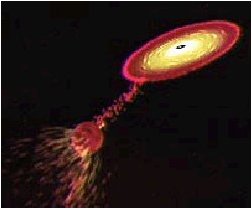 Right
image: One star, several times more massive than the
sun, experiences a core collapse, which produces a
neutron star. This neutron star slowly accretes matter
from its companion star, spinning faster as it absorbs
that star's rotational energy. Scientists say that such
neutron stars may cannibalize their companions, becoming
isolate millisecond pulsars. Right
image: One star, several times more massive than the
sun, experiences a core collapse, which produces a
neutron star. This neutron star slowly accretes matter
from its companion star, spinning faster as it absorbs
that star's rotational energy. Scientists say that such
neutron stars may cannibalize their companions, becoming
isolate millisecond pulsars.
Neutron
stars in low mass binary star systems such as the
one observed, where the companion has less mass than the
Sun, have been suspected as the sites where slowly
spinning neutron stars are spun-up to millisecond spin
periods. A neutron star has a powerful gravitational
field, and it can accrete gas from its
companion.
Matter
spirals toward the neutron star in the form of an
accretion disk, a journey visible in X-ray radiation. In
doing so, it transfers its orbital energy to the neutron
star, making it spin faster and faster, in this case,
185 times per second.
In the XTE
J0929-314 system -- only the third known accreting
millisecond pulsar of its kind and the second identified
with the Rossi Explorer in the past two months
-- the pulsar orbits its companion every 43 minutes. In
fact, the entire binary system would fit within the
orbit of the Moon around the Earth,
which takes a month, making this one of the smallest
binary orbits known.
While the
first two accreting, millisecond pulsars discovered lie
near the direction of the galactic center, the latest
discovery lies in a completely different direction. "One
advantage of XTE J0929-314," Morgan said, "is that
observations are less affected by crowded star fields
and interstellar gas and dust."
"This
binary system is a rare find," said Chakrabarty, who
works extensively on neutron stars in the Galaxy. "It
will help us to understand the link between
slow-spinning pulsars in binary systems, which are quite
common, and fast-spinning isolated pulsars, which are
commonly seen by radio astronomers."
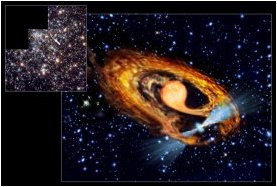 Left
image: The artist's impression shows the pulsar (seen in
blue with two radiation beams) and its bloated red
companion star. Click
image to enlarge. Left
image: The artist's impression shows the pulsar (seen in
blue with two radiation beams) and its bloated red
companion star. Click
image to enlarge.
With XTE
J0929-314 and its 10-Jupiter-mass companion, MIT
scientists have stumbled upon a pulsar that may be
further along its path to becoming isolated.
The
companion will eventually vanish as a result of both the
force of gravity pulling matter onto the neutron star
accretion, and the pressure from the resulting X-ray
radiation emitted from the neutron star blowing matter
away from the companion (ablation).
Also, this
is one of the faintest transients yet discovered with
the Rossi Explorer's All-Sky Monitor. "It was found by
superposing on the sky the thousands of snapshots that
our three panning cameras provide in a given week of
observations," said Remillard. "The results demonstrate
the value of this analysis exercise and the fact that
important science is not confined to the sources with
the brightest or most dramatic outbursts."
The Rossi
Explorer's All-Sky Monitor is an instrument designed and
constructed at MIT. Follow-up observations were made
with the Rossi Explorer's Proportional Counter Array
instrument, which was built by a team at NASA's Goddard
Space Flight Center.
Source: MIT Center for Space Research ;
NASA
Cosmiverse Staff Writer
E-Mail
this story to a friend
Post
your thoughts on this
story
Back to Today's
Headlines |