Initial
Notification
Date: Tue, 30 Apr 2002 16:07:18 -0400 (EDT)
From: Ron Remillard <rr@space.mit.edu>
Subject: [vsnet-alert 0] XTE J0929-314: a faint X-ray transient
The RXTE All-Sky Monitor has detected a faint
X-ray transient at R.A. = 09h29m22s, Decl. = -31 22'.8 (equinox J2000.0;
estimated 3' uncertainty at 90% confidence). The source is visible in sky
maps computed from 6-day intervals of ASM data. The average flux (2-12 keV)
was 15 +- 2 mCrab during 2002 April 13-18, inclusive, rising to 20 +- 2
mCrab (April 19-24), and 26 +- 1 mCrab (April 25-30). The error circle does
not contain any noteworthy sources in the Simbad catalogs. The ASM hardness
ratios suggest an X-ray spectrum similar to transients associated with
weakly magnetic neutron stars or some black hole systems. We encourage
optical and radio observations of this new transient.
Ron Remillard (M.I.T.) for the RXTE ASM Team at M.I.T.
and NASA Goddard Space Flight Center.
Transient
possible identification
XTE J0929-314
J. G. Greenhill, A. B. Giles, and K. M. Hill,
University of
Tasmania, report a possible optical counterpart for XTE J0929-314
(cf. IAUC 7888). Observations obtained around May 1.42-1.58 UT at
the 1-m Mt. Canopus telescope show a blue object with V about 18.8
at R.A. = 9h29m20s.16, Decl. = -31o23'02".7 (equinox J2000.0;
uncertainty +/- 0".5). The object was also detected in B, R, and
I, but not on a red plate from the Digitized Sky Survey. The
source faded significantly during the observations.
Comparando a astrometria feita por nós e
do VLA vemos que fomos no ponto e observamos antes (em tempo que os
australianos ) ...
Comparing our astrometry with VLA we can
see that our astrometry was a close encounter :))
Circular No. 7893
Central Bureau for Astronomical Telegrams
INTERNATIONAL ASTRONOMICAL UNION
Mailstop 18, Smithsonian Astrophysical Observatory, Cambridge, MA 02138,
U.S.A.
IAUSUBS@CFA.HARVARD.EDU or FAX 617-495-7231 (subscriptions)
CBAT@CFA.HARVARD.EDU (science)
URL http://cfa-www.harvard.edu/iau/cbat.html ISSN 0081-0304
Phone 617-495-7440/7244/7444 (for emergency use only)
XTE J0929-314
R. A. Remillard, Massachusetts Institute of Technology;
and J.
Swank and T. Strohmayer, Goddard Space Flight Center, NASA, report
the discovery of 185-Hz pulsations in XTE J0929-314 (IAUC 7889).
This source was observed in a brief pointed observation with RXTE
on May 2, while the average flux was 28 mCrab (2-30 keV). A power
spectrum was computed for 800 s of PCA data, and a highly
significant pulsation is seen at 185.09 Hz, with a strong harmonic
at 370.18 Hz. This is the third known pulsar in which pulsations
faster than 10 ms can be seen in the persistent x-ray emission.
Rasters across the source give an improved position R.A. =
9h29m18s, Decl. = -31o23'.1 (equinox J2000.0; systematic
uncertainty 1'), consistent with the optical candidate (IAUC 7889).
M. P. Rupen, V. Dhawan, and A. J. Mioduszewski,
National Radio
Astronomy Observatory, report the detection of a radio counterpart
to the x-ray transient XTE J0929-314 (IAUC 7888). Observations
with the Very Large Array (VLA) at 4.86 GHz show a source with flux
density 0.31 +/- 0.07 mJy on May 3, and 0.36 +/- 0.05 mJy on May 7,
at R.A. = 9h29m20s.194, Decl. = -31o23'03".41 (equinox J2000.0;
uncertainty +/- 0".3). This is 0".8 from the optical position
reported by Greenhill et al. (IAUC 7889) and provides strong
evidence that this optical identification is correct. Further
optical and x-ray observations are strongly encouraged.
P. Cacella, Brasilia, Brazil,
reports that an unfiltered CCD
image taken with a 0.25-m reflector shows a variable (mag 18.3)
that is possibly the optical counterpart to XTE J0929-314 at
position end figures 20s.22, 03".6.
Circular No. 7895
XTE J0929-314
A. J. Castro-Tirado, Instituto de Astrofisica de
Andalucia,
Consejo Superior de Investigaciones Cientificas (IAA-CSIC),
Granada; A. Caccianiga, Osservatorio Astronomico di Brera, Milano;
J. Gorosabel, IAA-CSIC; P. Kilmartin, University of Canterbury; P.
Tristram and P. Yock, University of Auckland; C. Sanchez-Fernandez,
Laboratorio de Astrofisica Espacial y Fisica Fundamental, Instituto
Nacional de Tecnica Aeroespacial, Madrid; and M. E. Alcoholado-
Feltstrom, Sociedad Malaguena de Astronomia, Malaga, communicate:
"We have observed the optical counterpart of the x-ray transient
XTE J0929-314 (IAUC 7888, 7889, 7893) with the European Southern
Observatory 3.6-m telescope at La Silla. Two 1200-s spectra (350-
800 nm) were obtained on May 6.96 and 7.96 UT. The combined
spectrum shows emission lines from the C III-N III (464.0-465.0 nm)
blend (EW = 0.14 nm for N III) and H-alpha (656.3 nm, EW = 0.14
nm). These lines are superposed on a blue continuum and are
typical of soft-x-ray transients in outburst. Monitoring with the
0.6-m telescope (+ MOA camera) at Mt. John Observatory reveals that
the counterpart has not changed in brightness by more than 0.1 mag
since May 1.6. Additional spectroscopy and photometry during the
outburst will be highly valuable."
Circular No. 7897
XTE J0929-314
D. K. Galloway, E. H. Morgan, R. A. Remillard, and D.
Chakrabarty, Massachusetts Institute of Technology, write:
"Observations of the recently discovered 185-Hz accreting
millisecond pulsar XTE J0929-314 (cf. IAUC 7888, 7889, 7893, 7895)
with RXTE/PCA on May 9.5 UT indicate that the pulsar is still
active at a flux level of about 20 mCrab (2-10 keV), down from 30
mCrab on May 2. Orbital Doppler shifts of the pulse frequency were
clearly detected. Further RXTE observations are scheduled over the
next few days. Multiwavelength follow-up observations are strongly
encouraged."
Circular No. 7890
XTE J0929-314
D. K. Galloway, E. H. Morgan, R. A. Remillard and D.
Chakrabarty, Massachusetts Institute of Technology, report: "We
have computed provisional orbital elements for XTE J0929-314 (cf.
IAUC 7897), using pulse frequency measurements from RXTE/PCA
observations between May 2.54 and 13.83 UT. Assuming a constant
pulsar spin frequency and a circular orbit, our preliminary orbital
solution has binary period 2614.75(15) s, projected semimajor axis
6.1(3) light-ms, and orbital epoch (time of 90 deg mean longitude)
2002 May 11.4941(2) UT at the solar-system barycenter. The derived
barycentric pulsar spin frequency is 185.1052(1) Hz. The inferred
mass function of 2.7 x 10**-7 solar mass is the smallest measured
for any stellar binary. For a 1.4-solar-mass neutron star, the
minimum companion mass is 0.008 solar mass (or 8.5 Jupiter masses).
The x-ray source was active at a flux of 13 mCrab (2-10 keV) on May
15.69. RXTE observations are continuing."
Astrometry
It was
near USNO A 0525-11776445 Mag
19.9B 17.8R at RA 09 29 20.010 Dec -31 22
57.38
Astrometry and Photometry
obtained from image below
XRAY1 C2002
05 01.07481 09 29 20.222-31 23 03.58 18.26 V
Date 05.01.2002
01:50 UT
RA 09 29 20.222
(+/- 0.28)
Dec -31 23 03.58
(+/- 0.36)
Mag V = 18.26 (+/-
0.2)
Additional astrometry data
\par
18:26:14 - Start 2002/05/01
\par
Image 1: C:\\Astronomia\\hoje\\XRayBin36.fit
\par Settings for Scale and
Orientation:
\par Focal Length = 1070.0mm
\'b1 10.0%, Position Angle = 0.0\'b0 \'b1 5.0\'b0, PointiDng = \'b1 5.0'
\par Image flipped:
horizontally vertically
\par Settings for CCD:
\par Pixel Width = 14.8\'b5m,
Pixel Height = 14.8\'b5m, Saturation = 60000
\par Settings for Object
Detection:
\par Aperture Radius = 2,
Detection Limit = 3.0, Min.FWHM = 0.70, PSF-Fit RMS = 0.25, Search Radius =
0.75
\par Settings for Reference
Star Matching:
\par Number of Stars = 100,
Search Radius = 2.0, Magnitude = 4.0mag - 25.0mag
\par 18:26:15 - USNO-A2.0: 2414
Records read (25.0' x 20.9')
\par Center Coordinates: RA =
09h 29m 22.00s, De = -31\'b0 22' 48.0"
\par 18:26:49 - Object List for
Image 1 (XRayBin36.fit):
\par 635 Detections (447 Stars,
447 Ref. Stars, 0 Movers)
\par 18:26:49 - Astrometry of
Image 1 (XRayBin36.fit):
\par 378 of 447 Reference Stars
used: dRA = 0.28", dDe = 0.36"
\par X = -1.749351601E-3
+1.422888075E-5*x +1.152344317E-6*y
\par Y = +1.856784761E-3
+1.144426963E-6*x -1.421529238E-5*y
\par Center Coordinates: RA =
09h 29m 11.83s, De = -31\'b0 21' 24.9"
\par Focal Length = 1037.3mm,
Rotation = 4.60\'b0
\par Pixel Size: 2.94" x 2.94",
Field of View: 15.5' x 11.3'
\par 18:26:49 - Photometry of
Image 1 (XRayBin36.fit):
\par 361 of 447 Reference Stars
used: dmag = 0.20mag
\par Zero Point: 22.64mag
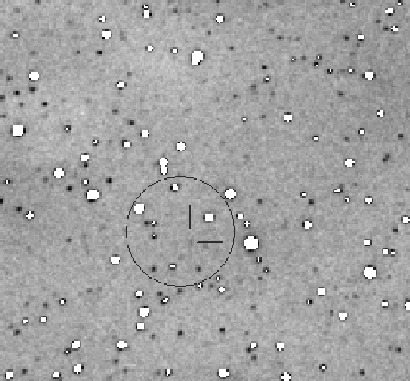
 Same image in
original scale
Same image in
original scale
Image SCT 10" F4.3 10
minutes exposition HX516 binned
Comparing with next night
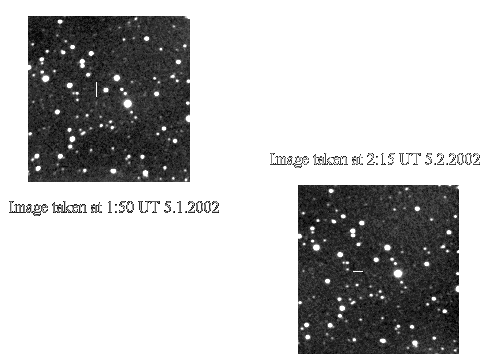
Astrometry showing USNO A star (right) and
probable Xray Transient (left)
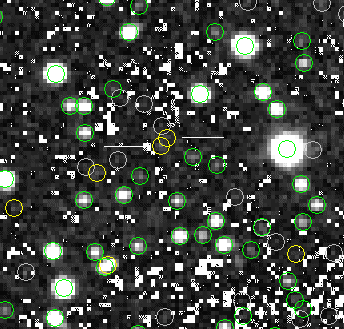
Comparison with DSS Images
Detail of source position and two faint
A2 stars. Compare the position of red cross below (probable XRay transient)
and identified stars in figure above.
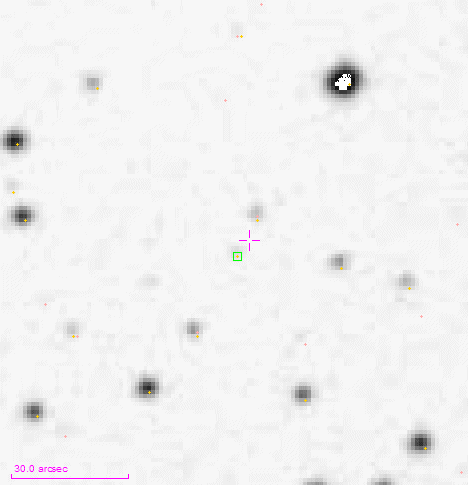
DSS IMAGES
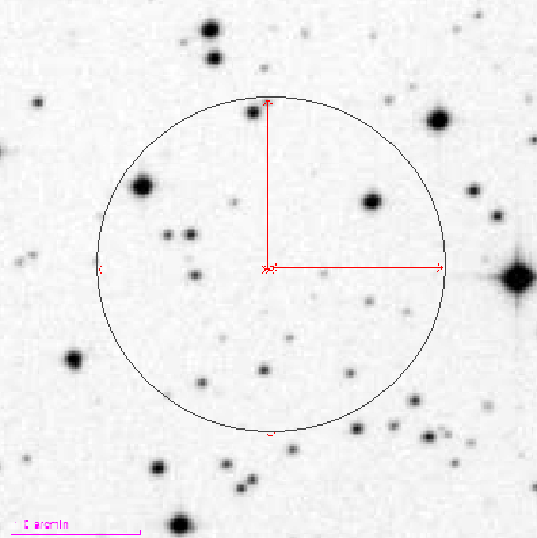
Imagem DSS2-Blue da Região
DSS2-BLue centered in target and
with a 1.5 arcmin radius
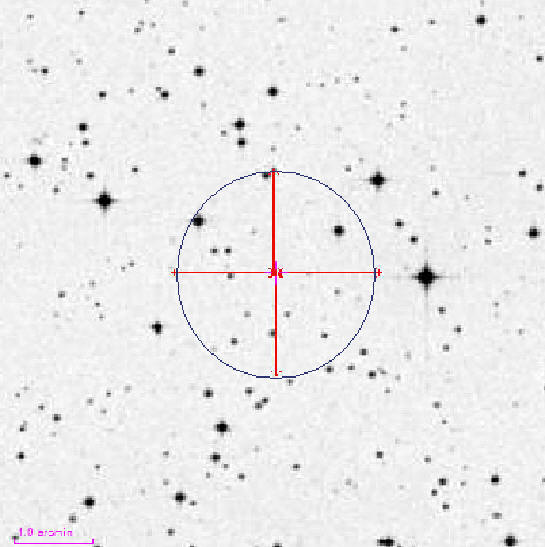
Imagem DSS-Red da Região
DSS-Red centered in target and
with a 1.5 arcmin radius